
Passive Transport System for Tracked Vehicles
PTSTV – Passive Transport System for Tracked Vehicles is a concept for a transport and manoeuvring device designed for the temporary movement of heavy tracked vehicles on paved roads. The solution makes it possible to use the tracked vehicle’s own powertrain to move on a wheeled platform, creating an additional mode of mobility between rail transport, heavy low-bed transporters, and direct movement on tracks.
The system has been designed as a passive solution: with no engine of its own, no separate operator, and no advanced electronic control systems. Once the vehicle has driven onto the platform and a section of the track near the drive sprocket has been temporarily disconnected, torque from the vehicle’s drive sprockets is transferred to the PTSTV wheels by means of chains. The platform’s forward movement results from the average rotational speed of the vehicle’s drive sprockets, while steering is performed by a hydro-mechanical system that converts the difference in rotational speed between the two sides of the vehicle into the steering angle of the platform wheels.
As a result, the driver can control the entire set from the tracked vehicle’s cabin, using its basic control system. PTSTV turns a tracked vehicle into a self-propelled wheeled set, reducing the need to drive directly on tracks over hard surfaces.
Why PSTPG?
The mobility of armoured forces does not end with the combat capability of the vehicle itself. Equally important is how quickly, safely, and flexibly heavy equipment can be moved to where it is needed. In practice, the transport of tracked vehicles is limited by the availability of railways, transshipment terminals, suitable rail wagons, heavy tractor units, and low-bed trailers. An additional challenge is the wear of tracks and running gear when driving on hard surfaces.
PTSTV does not replace railways or heavy transport sets. Instead, it creates a new link in the mobility chain, one that can increase the logistical freedom of manoeuvre of armoured forces, especially when railway infrastructure, heavy trailers, or tractor availability become constraints on response time.
Key Benefits
Reducing the burden on heavy equipment logistics
PSTPG can reduce pressure on railways, transshipment terminals, and the limited fleet of heavy transport sets. The system provides an additional option for relocating tracked vehicles without full dependence on conventional means of transport.
Protecting equipment service life
Reducing direct movement on tracks over paved roads can decrease wear on the running gear and lower operating costs, particularly in the case of frequent movements between bases, training grounds, workshops, and logistics hubs.
Greater operational flexibility
The system can support faster dispersion of forces, relocation of equipment away from permanent parking locations, and movement of vehicles in situations where conventional transport channels are overloaded, threatened, or unavailable.
Simple, passive integration
The platform uses the tracked vehicle’s own powertrain, while its moving elements are mechanically activated by the vehicle. The absence of an onboard drive system, additional operator, and complex electronics can increase reliability and simplify operation in military and industrial conditions.
Dual-use potential
Although PTSTV is primarily intended for armoured forces and the logistics of heavy military equipment, the solution may also be analysed in the context of civilian transport of heavy tracked vehicles, special-purpose machinery, and industrial equipment.
Example Use Scenarios
PTSTV can create the greatest value in operations where the rapid and flexible movement of a heavy tracked vehicle is required without full dependence on conventional logistics solutions:
• movements between a base, workshop, training ground, and parking areas,
• access to ports, railway terminals, and transshipment centres,
• rapid dispersion of equipment in crisis situations,
• support for exercises, rotations, and equipment movements within allied cooperation,
• relocation or evacuation of equipment when specialist transport availability is limited.
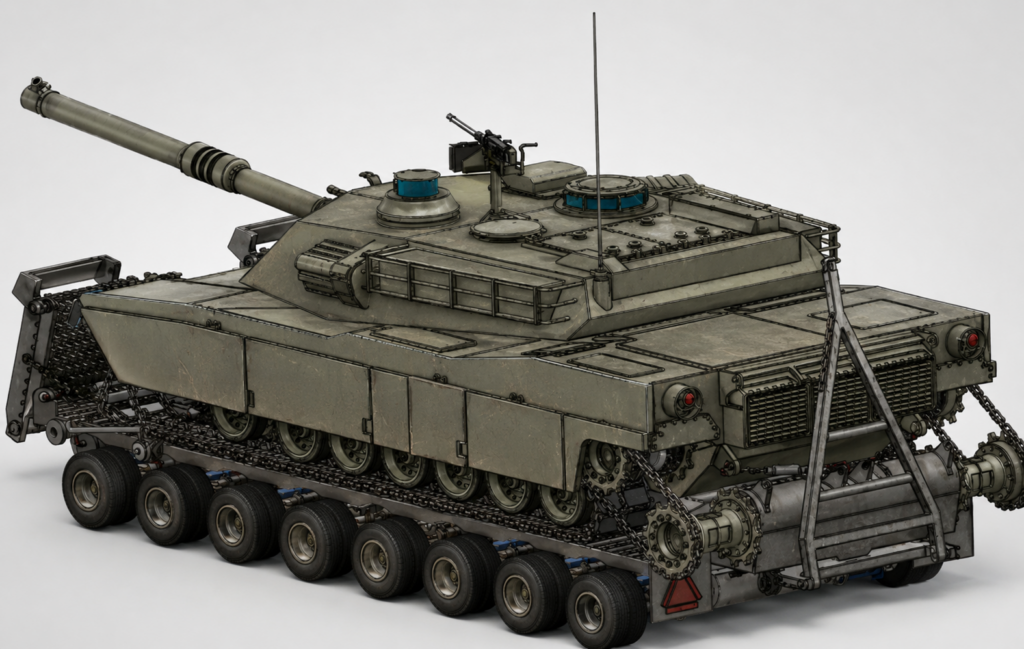
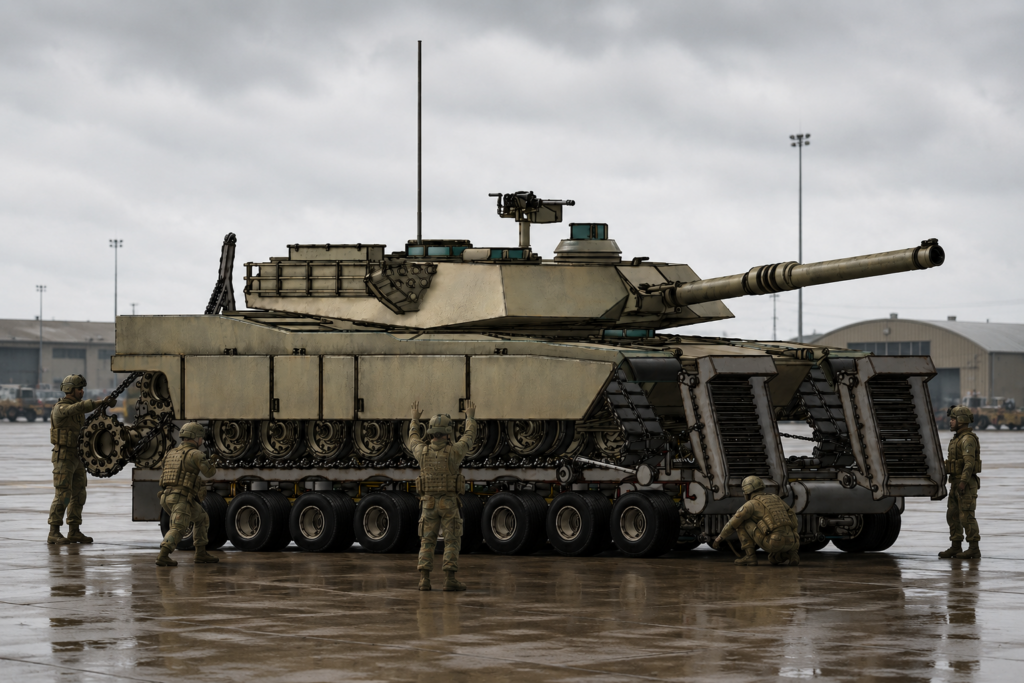
PTSTV Technical Specifications
Curb weight: 15 tonnes
Number of axles: 8, including 6 steerable and/or driven axles, depending on the variant
Minimum turning radius: 11.5 m
Drive coupling: 4 chains transferring torque from the drive sprockets
Transport without a vehicle: manoeuvring drawbar
Compatibility: any type of tracked vehicle
Formal Status and Patents
📜 PTSTV was submitted for patent protection to the Polish Patent Office in 2025 (application P.452578).