ACTIVE TOW
ENSAVID Active Tow is a technology concept intended for guiding vehicles, platforms and heavy self-propelled units in a leader–follower arrangement. The solution allows one leading unit to define the driving path, while the following unit actively responds to its movement, using its own drive, steering system and braking — without the need to equip it with a full autonomous system.
The system has been designed as an intermediate technology between classic passive towing and full vehicle autonomy. In passive towing, the following unit is essentially pulled by the leading vehicle, which, in the case of large masses, multi-unit sets or limited manoeuvring space, may cause problems with stability, driving path, forces in the connection and braking. Full autonomy solves some of these problems, but requires complex systems for perception, localisation, route planning and safety management.
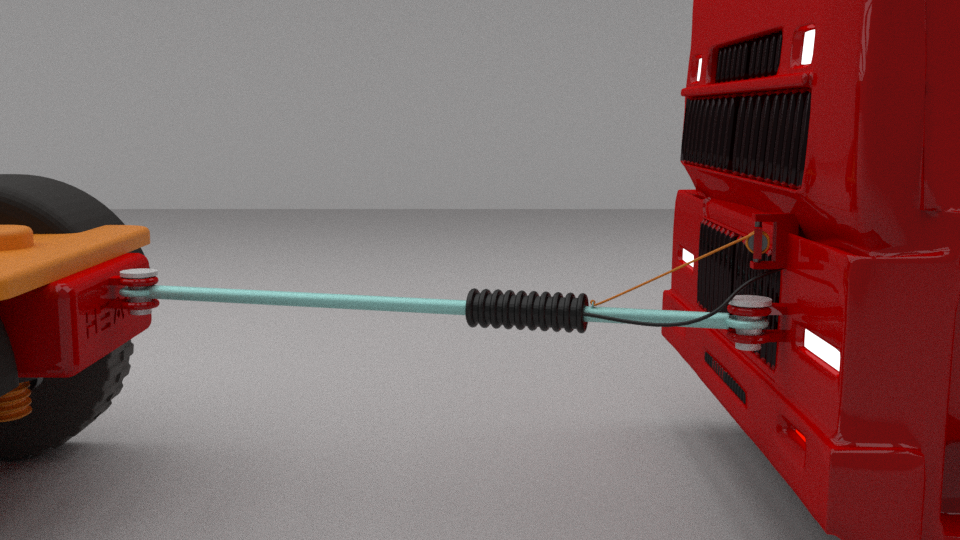
ENSAVID Active Tow proposes a different approach: the following unit does not have to independently plan the route or make operational decisions. It is automatically controlled in such a way that it follows the leader to which it is connected by a tow link. The following unit turns at an angle resulting from the position of the tow link, while extension or compression of the tow link may control drive, braking and maintaining a safe distance.
As a result, a vehicle, platform or heavy self-propelled unit is not passively pulled, but actively cooperates with the leader. The leader defines the route, while the following unit locally corrects steering, speed and braking, using its own motion systems.
Why Active Tow?
In many transport, industrial, logistics and special-purpose applications, it is possible to reduce costs by connecting vehicles into convoys that cover the same route close to one another. Such a convoy may consume less fuel than vehicles travelling separately, especially when it is possible to use the effect of reduced aerodynamic drag. It may also jointly move a heavy object that would normally require the use of specialised heavy transporters. Finally, the entire convoy may be led by one driver or operator, instead of a separate driver in each vehicle.
In such scenarios, full autonomy may be an excessive solution. The following vehicle does not have to independently recognise the entire surroundings, plan the route or make strategic decisions. Its task is to follow the leader, maintain the correct driving path, distance and motion stability.
ENSAVID Active Tow addresses exactly this technological gap. It enables active guidance of the following unit without the need to build a full autonomous system. This may reduce technical complexity, lower the cost of integration and accelerate implementation in applications where the key task is controlled following of a leader, not independent driving along any route.
Example application scenarios
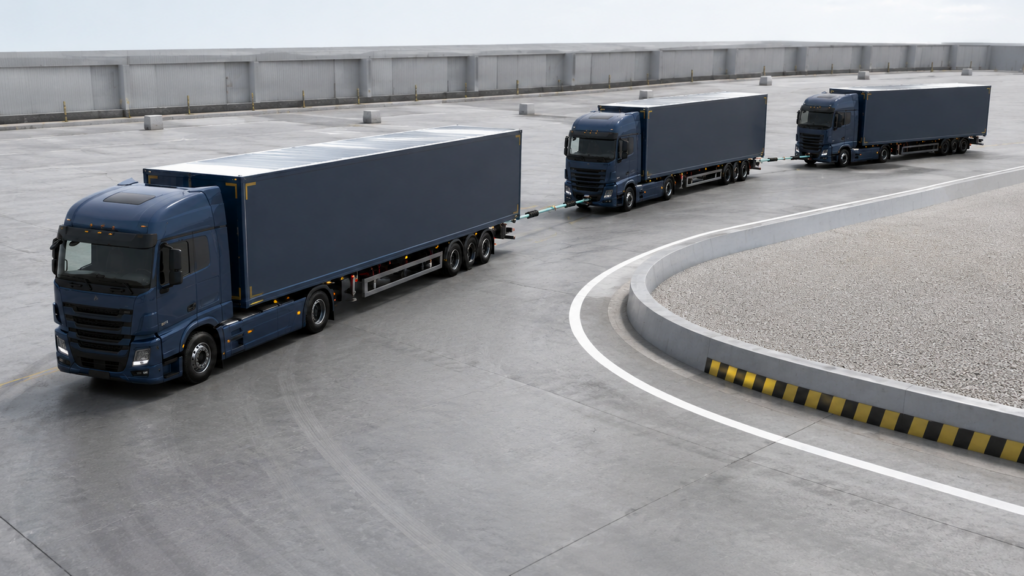
Convoys of self-propelled vehicles
In convoy movements, the leader defines the route, and subsequent units follow it without independently planning the journey. The benefit may be a reduced need to involve a separate driver or operator in each following unit, while at the same time using its own drive, steering and braking.
Guidance of active technical platforms
The system may enable technical platforms to be guided by a vehicle, robot, tug or operator. This is important where control from inside the platform is inconvenient, limited or potentially dangerous, while active correction of the driving path, speed and braking is still needed.
Modular logistics
In a modular logistics scenario, small trucks or platforms may collect goods from suppliers, join into convoys on shared sections of the route, and then separate and independently reach their destinations. The benefit may be a reduction in the number of transshipments, fuel consumption and drivers’ working time.
Military logistics
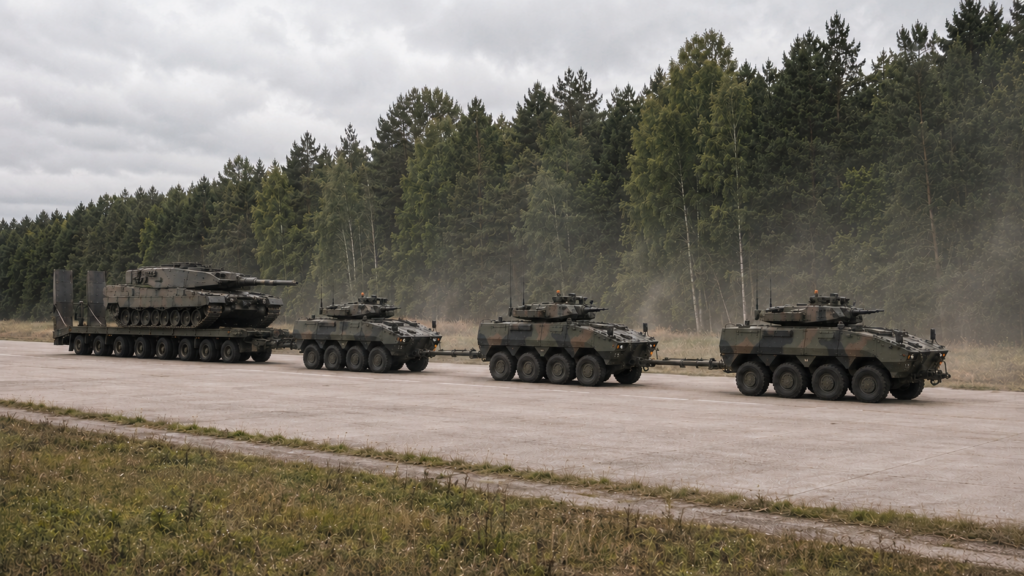
In military applications, Active Tow may be analysed as a way of using several self-propelled vehicles for the joint movement or recovery of heavy equipment, including damaged tracked vehicles. This may increase the flexibility of using available vehicles and reduce dependence on specialised heavy transport sets in selected operational scenarios.
Rescue and industrial logistics
In rescue, industrial and infrastructure environments, the system may support the movement of equipment, tools, batteries, medical supplies, gear or materials by a platform following a vehicle or an operator. The benefit is the possibility of transporting a heavy or inconvenient load without the need to manually push it, pull it or constantly operate it by an operator located on the platform.
Ports, terminals, warehouses and industrial plants
In ports, terminals, warehouses, industrial plants and technical support areas, Active Tow may be used to organise repetitive movements in spaces where routes are relatively predictable and full autonomy may be a solution that is too complex or too costly.
In each of the above scenarios, an important benefit is the local control of steering, drive, braking and distance by the following unit. The reaction to the position and change in length of the tow link may reduce the risk of oscillation, unwanted deviation from the driving path and excessive compressive or tensile forces in the connection.
The set of scenarios also shows the dual-use potential of the technology. ENSAVID Active Tow may be analysed both in civilian and special-purpose applications: in logistics, heavy-load transport, ports, terminals, rescue operations, military applications, infrastructure maintenance and mobile auxiliary platforms.
How does the system work?
The operating principle of ENSAVID Active Tow is based on the use of the geometric and mechanical relationship between the leading unit and the following unit.
- The leader defines the driving path.
- The following unit reads the position of the tow link relative to its own axis of movement.
- The angle of the tow link relative to the axis of the guided vehicle is used as a steering control signal.
- Extension or compression of the tow link may be used as a control signal for drive, braking and distance maintenance by the guided vehicle. Alternatively, the acceleration and braking signal of the leading unit may be directly replicated in the following unit.
- The following unit uses its own drive, steering system and braking, but does not have to independently plan the route.
- As a result, Active Tow turns a simple connection between vehicles into a control signal. It does not replace full autonomy where it is actually needed, but it may constitute a simpler and more specialised solution for tasks involving following a leader.
Regulatory environment
At the current stage of development of regulations concerning partially automated vehicles, leader–follower sets and assisted guidance systems, the most rational implementation path for ENSAVID Active Tow is use in controlled or operationally limited environments.
This applies in particular to manoeuvring yards, terminals, industrial plants, ports, warehouses, internal roads, test ranges, technical support areas and other areas where it is possible to clearly define traffic rules, permitted speeds, the scope of operator supervision, safety procedures and the responsibility of participants in the process.
This approach allows the technology to be developed in stages: first in conditions where operational and regulatory risks can be controlled, and then — after technical validation, refinement of procedures and collection of operational experience — to analyse the possibility of broader use of the system in more complex transport scenarios.
Formal status and patents
The ENSAVID Active Tow technology is covered by ENSAVID patent applications. The project is at the stage of a technological concept and seeking partners for validation in specific transport, industrial and special-purpose applications.